Brushing your dog’s teeth at home can help clear soft plaque, but it does not remove hardened tartar or replace veterinary dental care. Start today by letting your dog calmly investigate a pet toothbrush and toothpaste before you try to brush; a pleasant, gradual introduction can make the routine easier to accept. [1] [6]
Gather a safe brush and toothpaste before you begin
You will need:
- Toothpaste made for dogs
- A dog toothbrush, finger-mounted brush, or soft infant toothbrush
- A quiet place where your dog can remain comfortable
- Small rewards your dog enjoys, if rewards help create a pleasant interaction
Do not use human toothpaste. A dog may swallow it, and human products can upset digestion. Toothpaste containing xylitol is toxic to dogs, and some human products contain problematic amounts of sodium. [6]
Choose a brush that matches your dog’s size and that you can control easily. Dog toothbrushes come in angled, compact, multi-head, and finger-mounted designs. Some owners find a finger brush easier at first, while a soft infant toothbrush may suit some dogs. Ask your veterinarian to help you choose if you are unsure. [6]
Select a pet toothpaste with a flavor your dog accepts. The Veterinary Oral Health Council’s accepted-product list can be used as a resource when comparing dental products; treat it as a product-listing resource rather than as a guarantee that every listed item suits your individual dog. [6]
Before brushing, check whether your dog’s gums appear sore or inflamed, or whether your dog reacts as though the mouth is painful. Brushing an uncomfortable mouth can hurt and may make your dog less willing to cooperate. Ask your veterinarian about the mouth before starting if you suspect this problem. [1]
Chew toys and dental products also need thoughtful selection because some chew toys can injure teeth. Ask your veterinarian for a specific product recommendation rather than assuming that every dental chew or toy is safe. [1]
Introduce brushing as several short, comfortable steps
Puppies are often easier to introduce to brushing, but adult dogs can learn too. An adult dog may simply need more time to become comfortable with the routine. Praise and reassurance should be part of each stage, rather than making “finishing the brushing” the only goal. [6]
Let your dog inspect the supplies. Place the toothbrush and pet toothpaste where your dog can see and smell them. Offer praise when your dog remains calm. You can allow your dog to taste a small amount of pet toothpaste if the product directions permit it.
Practice touching the lips. When your dog is relaxed, briefly touch the outside of the lips and then stop. Gradually work toward gently lifting the lip. Use praise throughout. If your dog pulls away or becomes distressed, return to an easier touch rather than forcing the mouth open. Teaching cooperation is part of the brushing routine. [6]
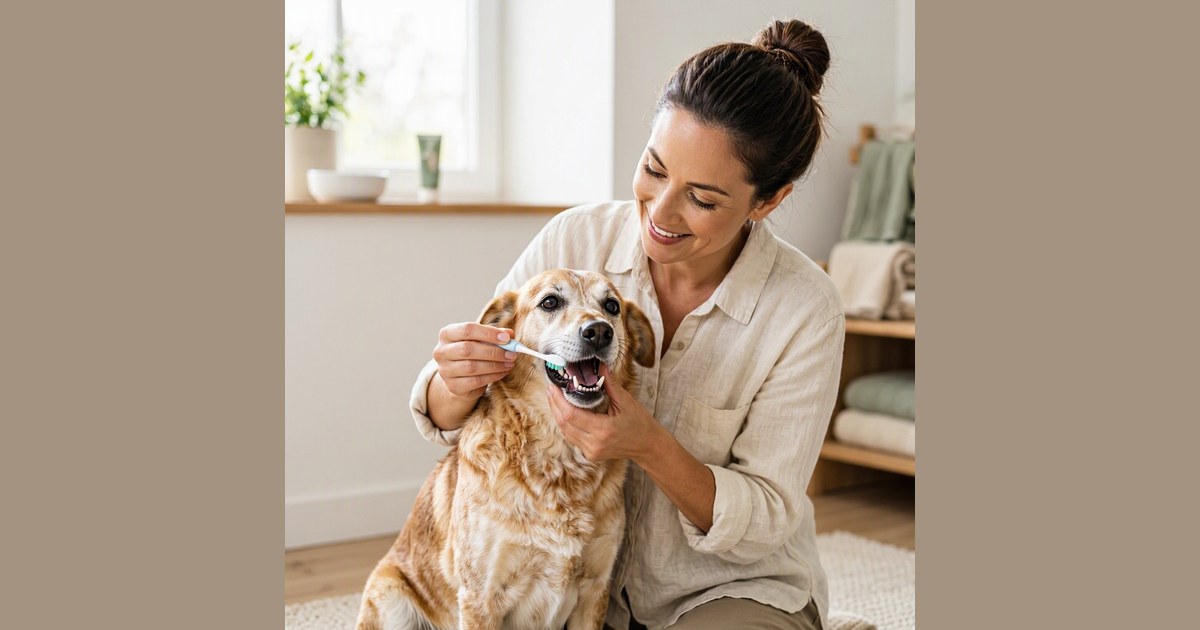
Add the brush without scrubbing. Put a little pet toothpaste on the brush. Lift the lip gently on one side with a free finger, or use your thumb and index finger on either side of the upper jaw to raise the lips. Touch the brush to a few teeth, praise your dog, and stop. [6]
Brush the easiest, most useful surfaces first. Begin with the large cheek teeth and the canine teeth, where deposits tend to develop quickly. Brush the outward-facing surfaces—the sides facing the cheeks—before trying other areas. These surfaces are the main area of periodontal damage. [6]
Use gentle pressure and expand slowly. Move the brush slowly and lightly so you do not irritate the gums. Add more teeth as your dog accepts the routine. Extending brushing to additional teeth may take days or weeks, so do not insist on every tooth during the first sessions. [6]
Work toward daily brushing. AAHA advises brushing every day to clear soft plaque. A gradual introduction can help you reach that routine, but the first sessions may be brief while your dog learns what to expect. [1]
Build toward about 30 seconds per side. VCA suggests working toward roughly half a minute of brushing on each side of the mouth. If your dog becomes uncooperative, prioritize the outward-facing surfaces rather than insisting on the inside surfaces or tooth tips. [6]
If your dog resists at any stage, stop before the interaction becomes a struggle. Return later to a step your dog already accepts, such as touching the lips or tasting the pet toothpaste. Praise and reassurance during every part of the process can support cooperation. [6]
After brushing, rinse the toothbrush well. Give each dog its own brush and replace the brush at three-month intervals. [6]
Know what brushing can and cannot remove
Plaque is a buildup of bacteria on the teeth. It can contribute to gingivitis, which is inflammation of the gums, and periodontal disease, which affects the tissues around the teeth. Left untreated, periodontal disease can lead to painful tooth loss. [6]
Daily brushing is aimed at soft plaque. Once plaque hardens into tartar, brushing cannot provide the same cleaning, so hardened tartar needs other care. Home brushing also does not remove the need for a veterinary dental assessment, dental X-rays, or treatment under anesthesia when those are needed. [1]
Use home brushing to control plaque between veterinary assessments; it does not replace them. [1] Periodontal disease is associated with measures of general health, but that association does not prove that it causes a particular illness elsewhere in the body. [5]
Arrange professional dental care on the veterinary schedule
Discuss dental health with your veterinarian from your dog’s first veterinary visit onward. AAHA considers an examination of the mouth while the dog is awake at six-month intervals appropriate. [4]
AAHA’s preventive protocol recommends a complete dental cleaning, polishing, and dental X-rays by age one for smaller dogs and by age two for larger dogs, even when obvious lesions are not present. Your veterinarian can adapt the plan to your dog’s size, age, mouth, and findings. [3]
A professional dental procedure uses general anesthesia. AAHA recommends general anesthesia for dental procedures such as cleaning and scaling, with airway protection using a breathing tube, monitoring, and support of vital functions. [2]
Dental X-rays are part of the recommended professional assessment and can be needed alongside cleaning and treatment under anesthesia. Home brushing cannot provide those parts of dental care. [1]
Contact your veterinarian when brushing is painful or dental care is due
Contact your veterinarian before beginning or continuing home brushing if your dog’s gums are sore or inflamed, or if brushing appears painful. Brushing an inflamed mouth can discourage future cooperation, so the mouth should be assessed rather than repeatedly forcing the routine. [1]
Also discuss professional care if your dog has not had the recommended dental assessment, cleaning, polishing, and X-rays for its age and size. The visit may include an awake-mouth examination, discussion of home products and brushing technique, and planning for a dental procedure if cleaning, X-rays, or treatment under anesthesia are needed. [4] [3] [1]
Today, offer your dog a pet toothbrush and a dog-safe toothpaste, praise calm investigation, and stop there if your dog is not comfortable. Then ask your veterinary clinic which brush, toothpaste, and dental-chew products fit your dog.
Related reading
References
- 2019 AAHA Dental Care Guidelines for Dogs and Cats - Recommending home oral hygiene and products. (2019) Link checked 2026-09-10.
- 2019 AAHA Dental Care Guidelines for Dogs and Cats - Anesthesia, sedation, and analgesia considerations. (2019) Link checked 2026-09-10.
- 2019 AAHA Dental Care Guidelines for Dogs and Cats - Preventing periodontal disease. (2019) Link checked 2026-09-10.
- 2019 AAHA Dental Care Guidelines for Dogs and Cats - Discussing regular oral healthcare. (2019) Link checked 2026-09-10.
- 2019 AAHA Dental Care Guidelines for Dogs and Cats - Periodontal disease and systemic health. (2019) Link checked 2026-09-10.
- VCA Animal Hospitals - Brushing Your Dog’s Teeth. (n.d.) Link checked 2026-09-14.