Why the Bones Inside Your Small Pet’s Neck May Matter More Than You Think
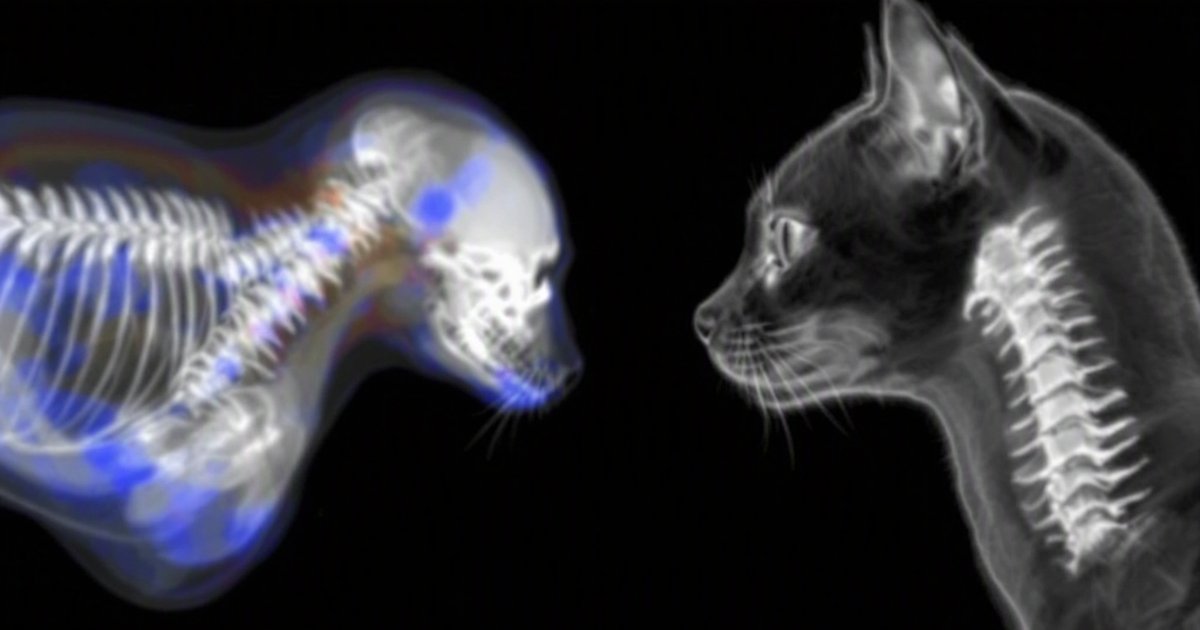
Upper-neck bone structure in toy-breed dogs and cats is not identical — and a new study suggests those differences could matter when a veterinarian or surgeon is planning treatment for a wobbly or unstable neck. Research published in Frontiers in Veterinary Science used highly detailed imaging to compare the internal structure of upper neck bones in small dogs and cats. The findings show that toy dogs and cats are built differently on the inside, which may influence how surgeons choose implants or approach stabilization procedures.
If your small dog or cat has ever been diagnosed with neck instability, or if your vet has mentioned the upper spine during a checkup, this research offers useful context for why treatment decisions in small pets can be complex.
What Is Upper-Neck Instability — and Why Does It Happen?
The very top of the spine contains two small bones: the atlas (first vertebra) and the axis (second vertebra). The joint between them is called the atlantoaxial joint. In toy-breed dogs — think Chihuahuas, Yorkshire Terriers, Pomeranians, and similar small breeds — a condition called atlantoaxial instability is relatively common. It happens when that joint becomes loose or unstable, sometimes because of a malformed or missing ligament or a bone abnormality present from birth.
An unstable atlantoaxial joint can press on the spinal cord, causing symptoms like neck pain, stumbling, weakness in the legs, or in severe cases, paralysis. Cats can also develop upper-neck problems, though for somewhat different reasons.
When surgery is needed to stabilize the joint, the surgeon must anchor implants — tiny pins, screws, or wire — into these small neck bones. How dense and well-connected those bones are determines how well the implants will hold.
How the Study Was Conducted
Researchers used a technique called micro-computed tomography — essentially an extremely detailed CT scan used in research settings — to examine neck bone samples from 20 dogs and 20 cats after death. This is called an ex vivo study, meaning the analysis was done outside a living body, on post-mortem tissue. The technique allowed the team to see the microscopic internal scaffolding of the bone, not just the outer shell.
Key study details:
- Subjects: 20 dogs and 20 cats
- Study type: Ex vivo micro-computed tomography (micro-CT)
- Bones examined: Upper cervical (neck) vertebrae
- What was measured: Internal bone density, connectivity, separation, and directional variation
What the Researchers Found
Toy-breed dogs generally had denser, more tightly connected bone in the upper neck area compared to cats. In practical terms, their internal bone scaffolding was more compact and better networked.
Cats, on the other hand, showed greater trabecular separation — meaning the internal scaffolding had more space between its struts — and higher anisotropy. Anisotropy just means the bone is structured differently depending on which direction you measure it, like wood grain that is stronger along one axis than another.
These differences are relevant to surgery. Denser, better-connected bone tends to hold implants more securely. Bone with more separation and directional variation can behave differently under stress, and surgeons may need to account for that when choosing where and how to place fixation hardware.
What This Could Mean if Your Pet Needs Neck Surgery
This study is about surgical planning, not something you can act on directly at home. But there are a few things worth understanding if your small dog or cat has a neck condition:
Species and size matter when it comes to surgical hardware. Surgeons already tailor their approach based on species and patient size. This study provides fine-detail evidence supporting that practice — the bone a toy dog has is structurally distinct from a cat’s bone, even when they are similar in overall size.
Not all neck surgeries are the same. A small-breed dog and a cat may look similar on the outside, but the internal anatomy of their neck bones differs in measurable ways. A veterinary surgeon who specializes in spinal procedures will factor in species-specific considerations like these when selecting implants and planning fixation.
Ask about the surgeon’s experience with your specific pet type. If your toy-breed dog or cat is referred for neck surgery, it is entirely reasonable to ask whether the surgical team has experience with that species and size. Bone architecture differences are one reason that specialty training matters.
Limitations of This Study
This is early-stage research with some important limitations. The sample — 20 dogs and 20 cats — is modest and may not capture the full range of variation across all breeds and sizes. Because the analysis was done on post-mortem tissue using a specialized research scanner, results may not perfectly reflect living patients.
Additional limitations include:
- Ex vivo design — bone properties can change slightly after death; results may differ in living animals
- Small sample — 20 per species may not represent all breed types or body sizes
- No clinical outcomes — the study measured bone structure but did not follow patients through surgery to assess implant performance
- Breed diversity — the study does not detail which specific breeds were included, limiting how broadly the findings can be applied
Larger studies examining a wider range of breeds, paired with surgical outcome data, would help confirm and extend these findings.
The Bottom Line
A detailed imaging study of 20 toy-breed dogs and 20 cats found measurable differences in upper-neck bone structure between the two species. Toy dogs had denser, more connected bone while cats showed more separation and directional variation in bone structure. These differences are relevant to veterinary surgeons planning stabilization procedures for neck instability in small pets.
If your small dog or cat has a neck condition that may require surgery, this research is a reminder that experienced, species-aware surgical planning makes a difference. Talk to your vet if you have any concerns about your pet’s neck health — early evaluation is always worthwhile.
This article summarizes peer-reviewed research for educational purposes. Always consult with your veterinarian for personalized advice about your pet’s health and behavior.