When Restless Nights May Signal More Than Just Bad Dreams
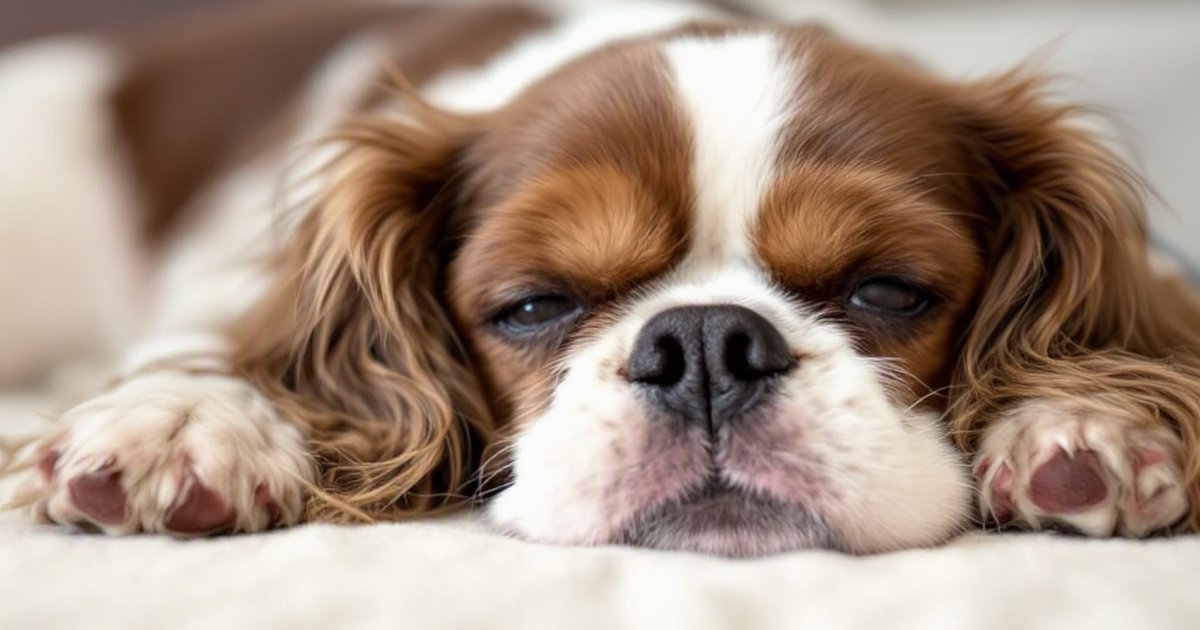
If your Cavalier King Charles Spaniel tosses and turns, repositions constantly, or seems unable to settle during sleep, a new study suggests that this pattern could be linked to Chiari-like disease — a neurological condition common in the breed. Research published in Animals found that Cavaliers showing signs of Chiari-like disease had noticeably more sleep disturbances than those without those signs, based on direct reports from their owners.
The finding matters because sleep problems in dogs are easy to overlook or dismiss as quirky behavior. This study suggests they may sometimes be an important clue worth raising with your vet.
What Is Chiari-Like Disease in Cavaliers?
Chiari-like malformation (also called Chiari-like disease or CM) is a condition where the back of the skull is slightly too small for the brain. Think of it like trying to fit a slightly oversized pillow into a just-too-small pillowcase — things get compressed and uncomfortable.
In Cavalier King Charles Spaniels, this is unfortunately very common. When the brain is crowded, it can disrupt normal fluid flow around the brain and spinal cord. That disruption can lead to pain, sensitivity around the neck and shoulders, and various odd behaviors.
One of the least-discussed signs is disrupted sleep — and that’s exactly what this study set out to examine.
How the Study Was Done
Researchers recruited 37 Cavalier King Charles Spaniels. Dogs were divided into two groups — 19 with signs compatible with Chiari-like malformation and 18 without those signs — based on owner-completed scores on the CHASE (Chiari-like malformation and Syringomyelia Screening) questionnaire, not MRI or direct clinical examination. Sleep was measured using the SNoRE 3.0 questionnaire, also completed by owners. Because both group assignment and sleep measurement relied entirely on owner-reported information, the study describes signs compatible with or presumed associated with CM/SM rather than confirmed disease in every dog.
Key study details:
- Subjects: 37 Cavalier King Charles Spaniels (19 compatible-signs group, 18 without)
- Study type: Owner-questionnaire comparative study
- Group assignment: Owner-completed CHASE questionnaire threshold
- Sleep measurement: Owner-completed SNoRE 3.0 questionnaire
- What was measured: Owner-reported frequency and type of sleep disturbances
No direct examination or MRI was performed on every dog, so results reflect owner-reported compatible signs rather than confirmed diagnoses.
What the Researchers Found
Dogs in the owner-reported compatible-signs group showed significantly more sleep disturbances than those in the no-signs group, based on SNoRE 3.0 scores. Owners reported behaviors such as restlessness, difficulty settling, and repeated repositioning during sleep.
The study found an association between owner-reported signs compatible with CM/SM and owner-reported sleep disturbance. Because both measures came from owner questionnaires — without direct examination or universal MRI — the findings do not establish that brain or spinal-cord pressure directly causes poor sleep, and they do not show that sleep disturbance is a reliable diagnostic marker. Still, the pattern suggests that sleep behavior may be worth raising with your veterinarian as one piece of a broader clinical picture.
Signs to Watch For During Your Cavalier’s Sleep
Based on what this study examined, here are sleep behaviors worth paying attention to if you own a Cavalier:
- Restlessness or frequent position changes — Can’t seem to get comfortable
- Repeated circling or repositioning before lying down
- Waking frequently without an obvious cause (like needing to go outside)
- Sleeping in unusual postures — sometimes dogs with neck discomfort avoid positions that put pressure on certain areas
- Scratching at the neck or shoulder area around sleep times, or after waking
None of these signs confirm Chiari-like disease on their own. But if you notice a pattern, it is worth mentioning at your next vet visit.
What You Can Do as a Cavalier Owner
Because Cavalier King Charles Spaniels are predisposed to Chiari-like malformation, being observant is one of the best tools you have. Here is how to put this research into practice:
Keep a simple sleep log. You do not need anything fancy — a note on your phone recording when your dog is restless, how often it repositions, and whether it seems uncomfortable is enough to share a useful picture with your vet.
Bring it up at routine checkups. Many owners assume disrupted sleep is normal dog behavior. Given this study’s findings, it is worth specifically mentioning to your vet if you see a pattern.
Don’t wait for dramatic symptoms. Chiari-like disease does not always show up as obvious limping or yelping. Subtle signs like poor sleep, neck sensitivity, or frequent phantom scratching (scratching the air near the shoulder) are worth mentioning to your vet.
Ask about neurological assessment. If your vet agrees there are grounds for concern, a referral to a veterinary neurologist and an MRI scan is the appropriate next step. Owner reports, as this study shows, can help build the case — but they cannot replace specialist examination.
Study Limitations to Keep in Mind
This study is observational, meaning it found an association between owner-reported compatible signs and owner-reported sleep disturbance — not a direct cause-and-effect relationship. Owner-reported data introduces natural variability and recall bias; two owners watching the same dog might describe its sleep differently.
Additional limitations include:
- No direct examination or MRI for every dog — group assignment relied on CHASE questionnaire scores, not confirmed diagnoses
- Owner and recall bias — both group assignment and sleep scores depended entirely on owner-completed questionnaires
- Uncontrolled comorbidities and medications — the study did not account for other health conditions or treatments that could affect sleep
- Small sample — 37 dogs is a modest study size; results may not generalize broadly
- No objective sleep measurement — no polysomnography or other instrumented monitoring was used
Larger studies combining objective sleep measurement with direct clinical assessment and imaging would help confirm and extend these findings.
The Bottom Line
A small owner-questionnaire study of 37 Cavalier King Charles Spaniels found an association between owner-reported signs compatible with Chiari-like malformation and owner-reported sleep disturbance. Because both measures relied on owner questionnaires and not every dog had MRI or direct examination, results should be interpreted cautiously.
If your Cavalier is a restless sleeper, keep a record of the patterns you observe and bring them to your next veterinary appointment. Your observations may help your vet decide whether further evaluation is warranted.
This article summarizes peer-reviewed research for educational purposes. Always consult with your veterinarian for personalized advice about your pet’s health and behavior.