Your German Shepherd’s Front and Back Legs Work Very Differently
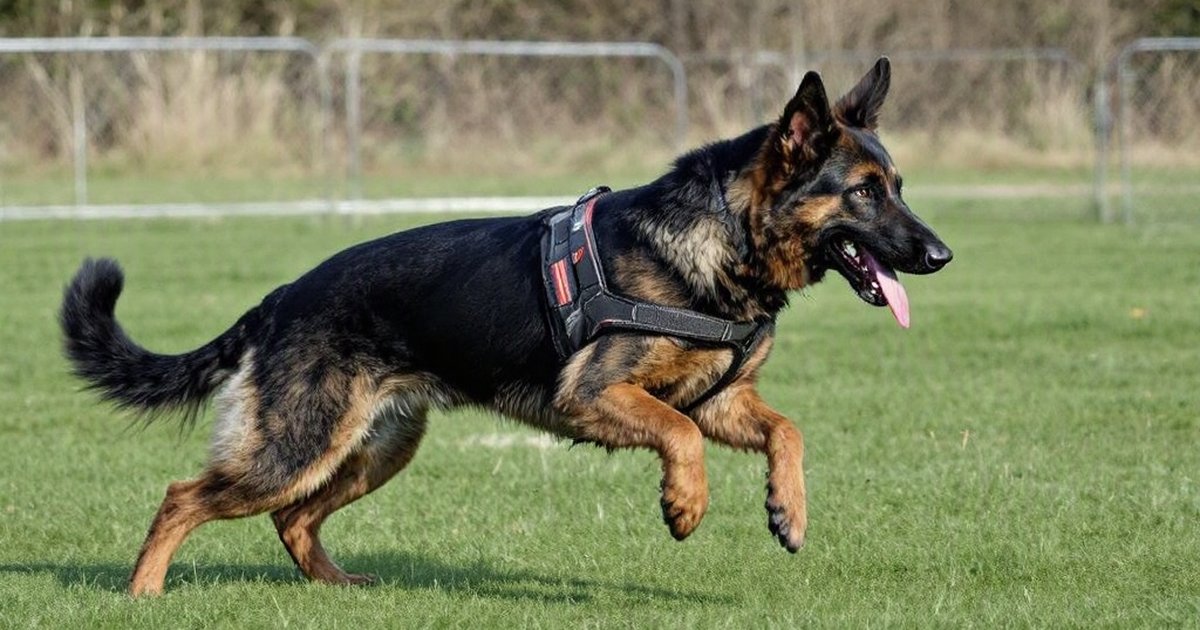
A new kinematic study — a study that analyzes motion and movement in detail — published in Frontiers in Veterinary Science found that German Shepherds rely on distinct movement strategies in their forelimbs (front legs) versus their hindlimbs (back legs) when cushioning impact forces during walking, trotting, and controlled drop-landings.
For German Shepherd owners, this matters. These dogs are athletes by nature — whether they’re working dogs, sport competitors, or simply energetic family companions. Understanding that the front and back halves of your dog don’t handle physical stress the same way adds to a growing picture of canine biomechanics that veterinarians can use to inform movement assessments.
Why Biomechanics Matters for Active Dogs
Biomechanics is just a fancy word for how the body moves — how muscles, joints, and bones work together to produce motion and handle forces like landing from a jump or running on a hard surface.
In dogs, the forelimbs carry a larger share of the body’s weight at rest and absorb much of the forward impact. The hindlimbs act more like an engine — they generate force and push the dog forward. Because these two sets of legs do such different jobs, it makes sense that they would use different strategies to cope with impact.
What this study does is document those differences in German Shepherds specifically, giving researchers and vets a clearer picture of how this breed manages physical forces during specific tested activities.
What the Researchers Did
The researchers used kinematic analysis to study how German Shepherds move. Think of it like a very precise slow-motion video analysis: specialized cameras or motion-capture sensors track exactly how each part of the leg moves — how joints bend, how angles change, and how the body absorbs and redirects forces at each step.
The study enrolled four clinically healthy adult male German Shepherd police dogs. Each dog completed ten trials per condition, and the researchers analyzed dog-level means across three conditions:
- Walking
- Trotting
- Controlled drop-landing from a 0.5 m platform
By comparing forelimb and hindlimb data side by side across these conditions, the team identified the distinct mechanical patterns each set of legs used to absorb impact.
Key aspects of the study:
- Subjects: 4 clinically healthy adult male German Shepherd police dogs
- Method: Kinematic motion analysis
- Conditions tested: Walking, trotting, and 0.5 m drop-landing
- Analysis: 10 trials per dog per condition; dog-level means
- Published in: Frontiers in Veterinary Science
This is a small preliminary observational study — it describes what the researchers measured rather than testing a specific treatment. The findings offer useful biological insight about these specific conditions, but further research in larger samples is needed before broad clinical guidance can be drawn.
What the Study Found
Front Legs and Back Legs Use Different Shock-Absorption Strategies
The central finding is that German Shepherds don’t use a one-size-fits-all approach to managing impact across walking, trotting, and drop-landing. Their forelimbs and hindlimbs rely on different movement patterns to cushion these forces.
The study doesn’t say that one set of legs is more injury-prone than the other. But it confirms they are biomechanically distinct across the tested conditions — meaning the type of mechanical demands each experiences differs between front and back.
Possible Relevance for Training and Injury Research
The researchers note that these movement differences may have relevance for understanding how training load affects dogs. The study is descriptive, so it does not test or recommend specific training protocols, but the documented kinematic differences provide a foundation for future work exploring injury risk and conditioning in this breed.
What This Means for Your German Shepherd
This research is a small preliminary study — four dogs under three specific controlled conditions. It does not, on its own, establish guidelines for training surfaces, warm-up routines, or activity selection. However, it reinforces that the front and back halves of your dog have distinct movement mechanics, which your veterinarian can factor into a movement assessment.
When to Talk to Your Veterinarian
Bring your German Shepherd in if you notice:
- Limping or favoring one leg, even occasionally
- Reluctance to jump, climb stairs, or play as usual
- Swelling, heat, or tenderness around any joint
- Muscle differences between the two shoulders or hips (one side looks less full)
- Stiffness after rest, especially following exercise
If your dog is involved in sport, working dog activities, or intensive training, ask your vet — or a veterinary rehabilitation specialist (a vet with extra training in physical therapy and movement assessment) — about a gait evaluation.
Study Limitations
This is a small preliminary kinematic study involving four clinically healthy adult male German Shepherd police dogs tested under three controlled conditions (walking, trotting, and 0.5 m drop-landing). Its findings describe movement patterns under those specific conditions only and cannot be generalized to other activities, surfaces, or dog populations without further research.
The findings are also breed-specific — while the underlying biomechanical principles may have broader relevance, the movement patterns documented here were observed in a small group of German Shepherd police dogs and may not transfer directly to other breeds, ages, fitness levels, or everyday working conditions.
Larger, more diverse studies would be needed to confirm and extend these observations into clinical or training recommendations.
The Bottom Line
A small kinematic study in Frontiers in Veterinary Science found that four German Shepherd police dogs used different movement strategies in their front legs compared to their back legs when absorbing impact during walking, trotting, and a controlled 0.5 m drop-landing. The research is preliminary and observational; it describes biomechanical differences under specific tested conditions rather than providing training or clinical guidance.
If you have an active German Shepherd, your veterinarian is the right partner for movement assessment. The science is building toward more targeted understanding of canine limb mechanics — and this study is one early piece of that picture.
This article summarizes peer-reviewed research for educational purposes. Always consult with your veterinarian for personalized advice about your pet’s health and behavior.