The benefit
When your veterinarian tells you your dog is overweight, the instinct is to focus on the number on the scale. But a new imaging study suggests that number alone may not tell the whole story. Where your dog stores its fat—not just how much it carries—appears to matter when it comes to metabolic health risk. Understanding this distinction could change how you and your vet approach weight management.
The science
Fat in mammals falls into two broad categories. Subcutaneous fat sits just beneath the skin and is relatively easy to detect by touch or by looking at a dog’s silhouette. Visceral fat (from the Latin viscera, meaning internal organs) accumulates deep inside the abdomen, surrounding the liver, intestines, and other organs. In human medicine, visceral fat has long been linked to a higher risk of metabolic diseases—conditions such as insulin resistance, chronic inflammation, and cardiovascular problems—even in people whose total body weight appears normal.
Whether the same relationship holds in dogs has been less clear. The standard clinical tool for assessing canine weight—the body condition score (BCS)—rates dogs on a 1–9 or 1–5 scale based on visual inspection and palpation of the ribs, waist, and spine. It is practical and widely used, but it captures overall fatness rather than the internal distribution of fat.
What the study did
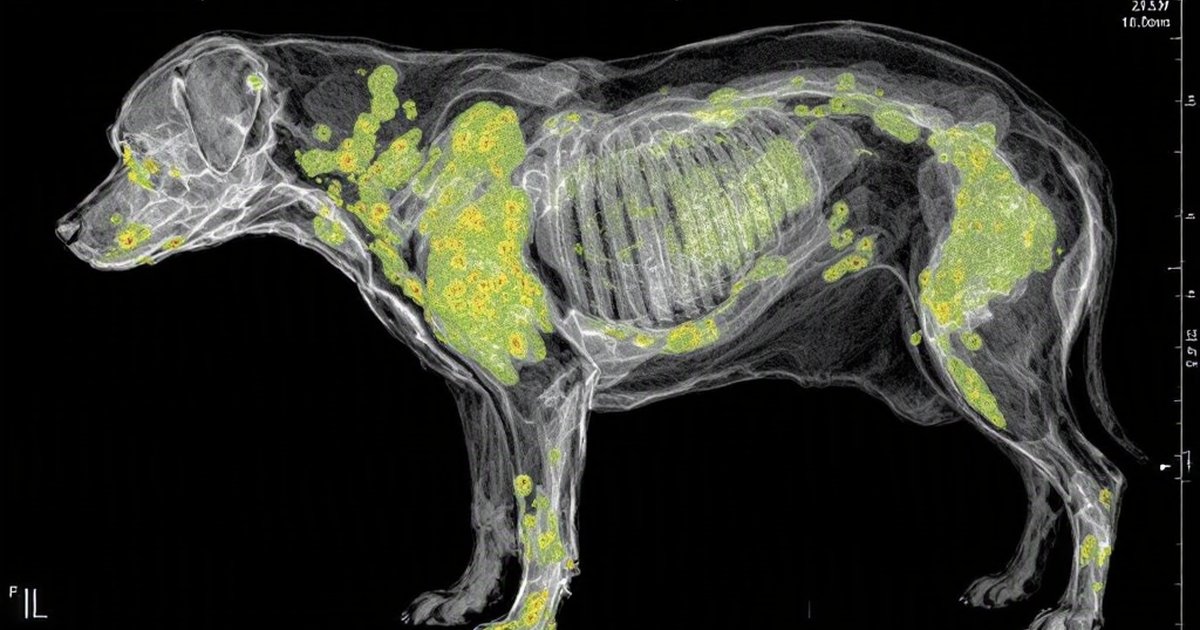
Researchers used computed tomography (CT)—the same type of cross-sectional imaging used in human hospitals—to assess fat distribution in 205 dogs presenting to a veterinary hospital. CT imaging allowed the team to distinguish and measure subcutaneous and visceral fat deposits with a level of precision that external assessment alone cannot provide.
This study design is what makes the findings notable. Rather than relying on weight, BCS, or rough estimates, the researchers produced detailed images of exactly where fat was stored inside each dog’s body, then looked for patterns linking fat location to the dog’s age, health status, and existing conditions.
Key findings
The study found that visceral fat distribution was associated with both age and the presence of certain diseases. In other words, dogs that stored a higher proportion of their fat internally—rather than under the skin—were more likely to be older and to have concurrent health conditions. This parallels what researchers have observed in humans and suggests that the type of fat a dog carries may carry its own health signal, independent of overall body condition.
Critically, the findings also reinforced that body condition scoring may not fully capture this internal fat pattern. Two dogs with identical BCS ratings could have very different visceral-to-subcutaneous fat ratios, meaning one could face a meaningfully higher metabolic risk than the other—a risk that would be invisible to standard clinical assessment.
CT imaging, by contrast, provided a detailed internal map of fat distribution that surface-level examination simply cannot replicate.
Real-world application
For most pet owners, a CT scan is not a routine veterinary visit—it is a specialist tool typically used when a more serious medical question is being investigated. But the study’s findings carry practical weight even for everyday care.
First, they underscore the limits of relying on weight or body condition score alone. If your dog’s BCS appears normal or only mildly elevated, that does not rule out a higher-risk fat distribution pattern, particularly in older dogs or those with known health conditions.
Second, they highlight why age matters in obesity assessment. An older dog that appears only slightly overweight may warrant more attention to metabolic health than a younger dog at the same BCS—because visceral fat accumulation was linked to age in this study.
Third, they suggest that dogs with certain diseases may be more likely to carry fat viscerally, which could in turn worsen those conditions. This bidirectional relationship is worth discussing with your vet when reviewing your dog’s overall health picture.
How to implement
- At your dog’s next wellness exam, ask your veterinarian not just about weight, but about the pattern of weight distribution—are there signs of abdominal distension or internal fat accumulation?
- For older dogs or those with metabolic conditions such as hypothyroidism, Cushing’s disease, or diabetes, ask whether additional imaging or bloodwork might reveal hidden metabolic risks.
- Do not assume a normal body condition score means all is well; let it prompt a broader conversation about your dog’s health rather than end it.
- Focus on diet and activity quality, not just quantity. Consistent, appropriate exercise and a veterinarian-approved diet remain the best tools available to owners for managing both total fat and internal fat accumulation.
What to expect
Most healthy, lean dogs do not need specialized imaging for fat assessment. The relevance of this research is greatest for dogs who are overweight, older, or already managing a chronic condition. In those cases, it may be worth asking your veterinarian whether the standard BCS approach is sufficient or whether additional diagnostic steps would paint a clearer picture of health risk.
Potential concerns
- CT imaging is significantly more expensive than a standard exam and requires anesthesia or heavy sedation in dogs, so it is not appropriate as a routine screening tool.
- The study’s sample came from a veterinary hospital population, meaning the dogs were likely sicker, on average, than the general pet population—which may influence how widely the findings apply to healthy dogs in the community.
- The relationship between visceral fat and disease may be bidirectional: disease may cause changes in fat distribution, rather than fat distribution always causing disease.
Study limitations
The researchers acknowledged that their findings are based on a specific population of hospital-presenting dogs and may not generalize to all breeds or to healthy dogs seen only for routine wellness care. Different breeds carry fat differently, and breed-specific reference ranges for visceral fat do not yet exist. The observational study design means associations—not cause-and-effect relationships—were identified. Larger studies across diverse breeds and health statuses would strengthen the conclusions.
Bottom line
A dog’s body condition score tells you something important, but it does not tell you everything. This CT imaging study of 205 dogs found that where fat is stored inside the body—particularly the accumulation of visceral fat around internal organs—is linked to age and disease in ways that external assessment can miss. The practical message for pet owners is to look beyond the scale: work with your veterinarian to consider your dog’s full health picture, not just its weight, especially as your dog ages or if it manages a chronic condition.
Disclaimer
This article summarizes peer-reviewed research for educational purposes. Always consult with your veterinarian for personalized advice about your pet’s health and behavior.